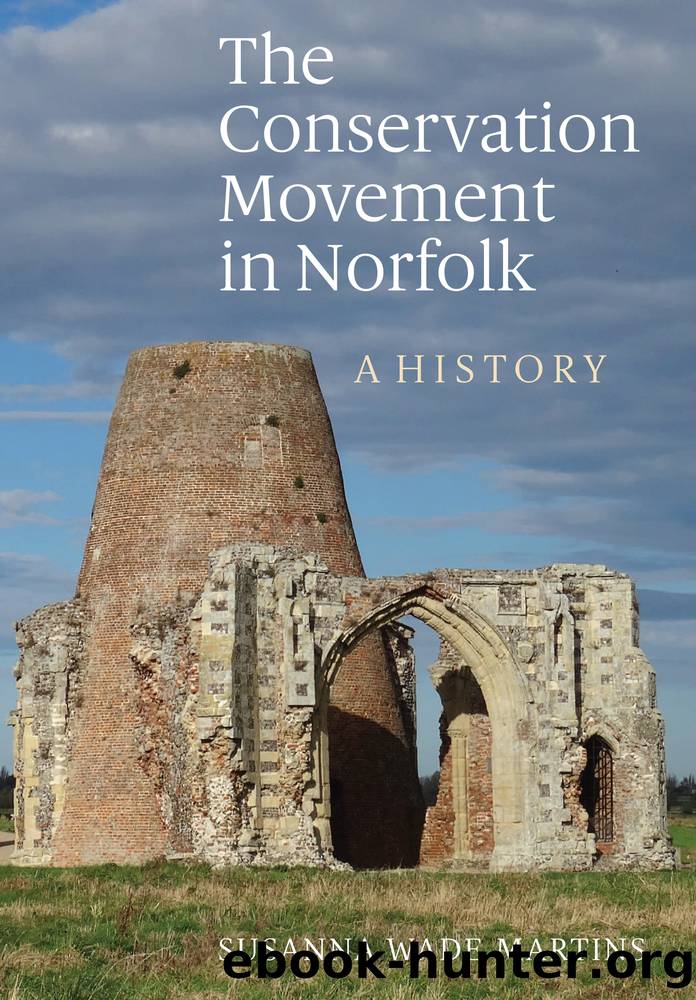
The Conservation Movement in Norfolk by Susanna Wade Martins
Author:Susanna Wade Martins
Language: eng
Format: epub
ISBN: 9781782045212
Publisher: Boydell & Brewer Group Ltd
Published: 2015-03-30T16:00:00+00:00
27 Dr Sydney Long (1870â1939), founder of the Norfolk Naturalistsâ Trust. He is shown here at Scolt Head.
28 The Cley marshes were the first acquisition of the Norfolk Naturalistsâ Trust in 1926. The scrapes to attract waders have been dug recently and the new Visitor Centre can be seen in the bottom right-hand corner.
Long was well aware that the NNNS was an academic society, unsuited to the owning of land. He had been a prime mover in raising the funds for the purchase of Scolt Head and was a member of the Blakeney Point Local Management Committee. He had observed the National Trustâs reluctance to overstretch itself and when, in March 1926, 407 acres of the Cley marshes plus a building plot came on the market, Long purchased it himself. Frustrated by the procrastination of the National Trust, he then invited a group of like-minded individuals to a lunch in Cley to consider the setting up of a Naturalistsâ Trust so that the marshes could be vested in the hands of, and administered by, local naturalists. As a result, the NNT was formed as a company limited by guarantee. The aims in the Memorandum of Association, under 24 headings, were deliberately wide. The most significant were âTo protect places and objects of natural beauty or of ornithological, botanical, geological or scientific interest from injury, ill treatment or destructionâ, to âestablish ⦠reservesâ and to accept subscriptions. The membership should not exceed 200 and life membership was £10.
The first meeting of the Trust was on 30 November 1926 in the solicitorsâoffices of Cozens-Hardy and Jewson, and their Castle Chambers was to be the registered office. Others present included such well-known names as R.J. Colman and G.H. Gurney, as well as Dr Long. Surprisingly, after some discussion, shooting out of the breeding season at Cley continued to be allowed, perhaps because C. Mclean, who was also a member of the shooting syndicate, was present. A new five-year agreement with the syndicate, at £225 per annum, was agreed. The grazing tenancies on the marsh would continue, but were rearranged so that the central part was reserved for nesting birds. Twenty-six life members (all from the local gentry) were admitted. The first AGM was held at the Castle Museum in February 1927, when the accounts were presented and agreed.29
The main concern of the early conservationists was the north Norfolk coast, with its marshes. Salt marshes tended to be dismissed by the romantic admirers of the âpicturesqueâ as flat, bleak and inhospitable. However, their importance for breeding and migrating birds was critical. In 1929 a house at Brancaster Staithe was acquired and in 1937 the adjoining cottage was bought to extend visitor facilities. In 1937 the Duchess of Bedford gave land at Burnham Overy Staithe, while Little Eye and Great Eye at Salthouse were bought in 1937 with the help of a grant from the Pilgrim Trust. These areas of coastal marshland offered some of the best vantage points for observing migrating and wading birds.
The Broads were, as we have seen, vulnerable to disturbance by tourists.
Download
This site does not store any files on its server. We only index and link to content provided by other sites. Please contact the content providers to delete copyright contents if any and email us, we'll remove relevant links or contents immediately.
| Africa | Americas |
| Arctic & Antarctica | Asia |
| Australia & Oceania | Europe |
| Middle East | Russia |
| United States | World |
| Ancient Civilizations | Military |
| Historical Study & Educational Resources |
The Dawn of Everything by David Graeber & David Wengrow(1707)
The Bomber Mafia by Malcolm Gladwell(1624)
Facing the Mountain by Daniel James Brown(1553)
Submerged Prehistory by Benjamin Jonathan; & Clive Bonsall & Catriona Pickard & Anders Fischer(1455)
Wandering in Strange Lands by Morgan Jerkins(1430)
Tip Top by Bill James(1416)
Driving While Brown: Sheriff Joe Arpaio Versus the Latino Resistance by Terry Greene Sterling & Jude Joffe-Block(1376)
Red Roulette : An Insider's Story of Wealth, Power, Corruption, and Vengeance in Today's China (9781982156176) by Shum Desmond(1359)
Evil Geniuses: The Unmaking of America: A Recent History by Kurt Andersen(1354)
The Way of Fire and Ice: The Living Tradition of Norse Paganism by Ryan Smith(1336)
American Kompromat by Craig Unger(1315)
F*cking History by The Captain(1304)
It Was All a Lie by Stuart Stevens;(1300)
American Dreams by Unknown(1286)
Treasure Islands: Tax Havens and the Men who Stole the World by Nicholas Shaxson(1274)
Evil Geniuses by Kurt Andersen(1257)
White House Inc. by Dan Alexander(1212)
The First Conspiracy by Brad Meltzer & Josh Mensch(1174)
The Fifteen Biggest Lies about the Economy: And Everything Else the Right Doesn't Want You to Know about Taxes, Jobs, and Corporate America by Joshua Holland(1126)
